


Interregnum: Ashes of Empire
A strategy game of post-imperial grand strategy
Game world
Almost 176 years ago, the Empire collapsed, giving rise to new factions.
Apart from the factions that emerged from the ashes of the Empire, other factions also appeared in the galaxy.
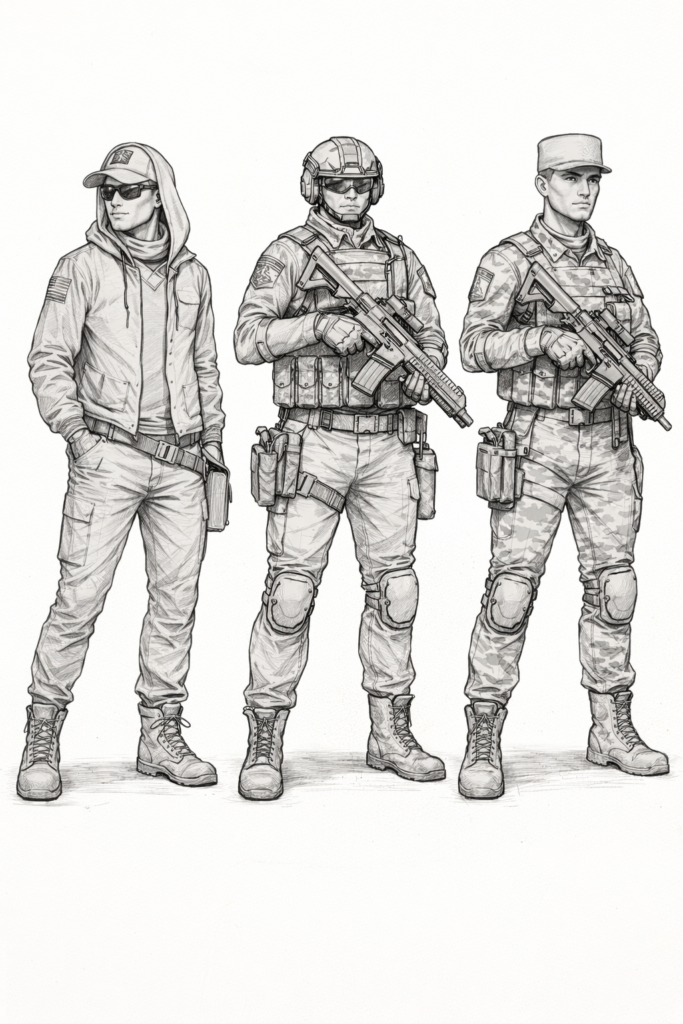
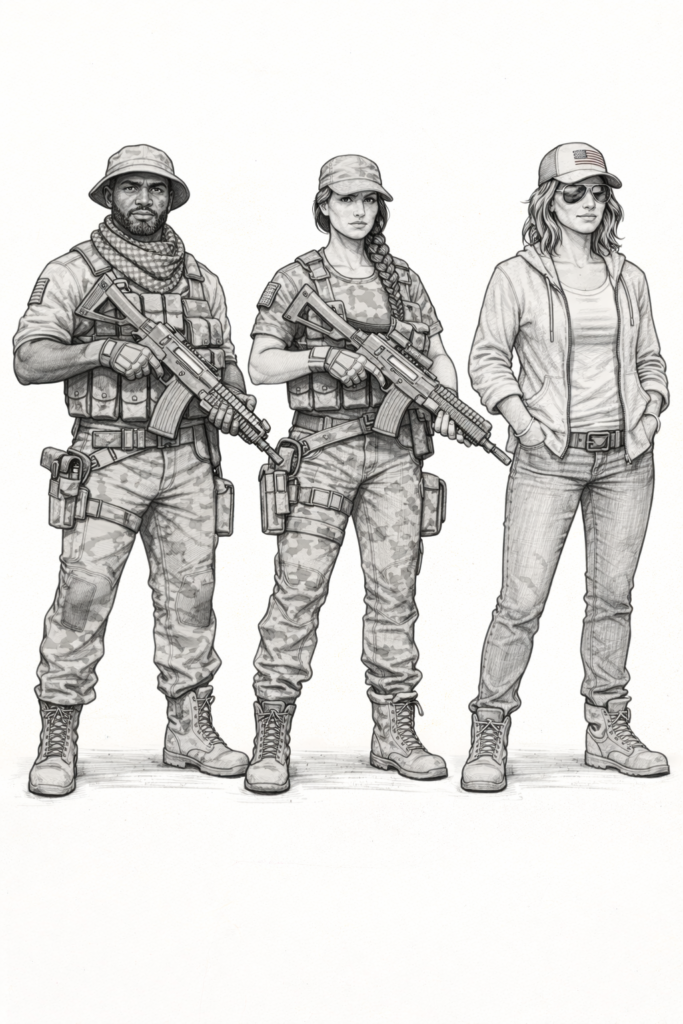
Federation
It was modeled after ancient federated states.
Each world has the right to its own laws, but the Federation Government enacts federal law, which takes precedence over the systems’ laws.
Economy:
Primarily based on corporations and megacorporations, which have full freedom of action within the law.
Society:
Every citizen has the right to vote, although elections have been suspended for decades due to ongoing armed conflicts.
Everyone has complete freedom; everyone has the right to choose their career and to change it as they wish.
Military:
It is divided into the Federation Army and the Foreign Legion.
The army forms the core and pride of the Federation, and only citizens are allowed to join. They receive the best equipment and top-level training.
The Legion, on the other hand, recruits all “volunteers” regardless of their origin. For years of war, it served as cannon fodder to stabilize the front or as the vanguard creating new fronts. Today, after nearly 15 years of modernization and structural changes, the Legion is a strong competitor to the Army.
Hegemony
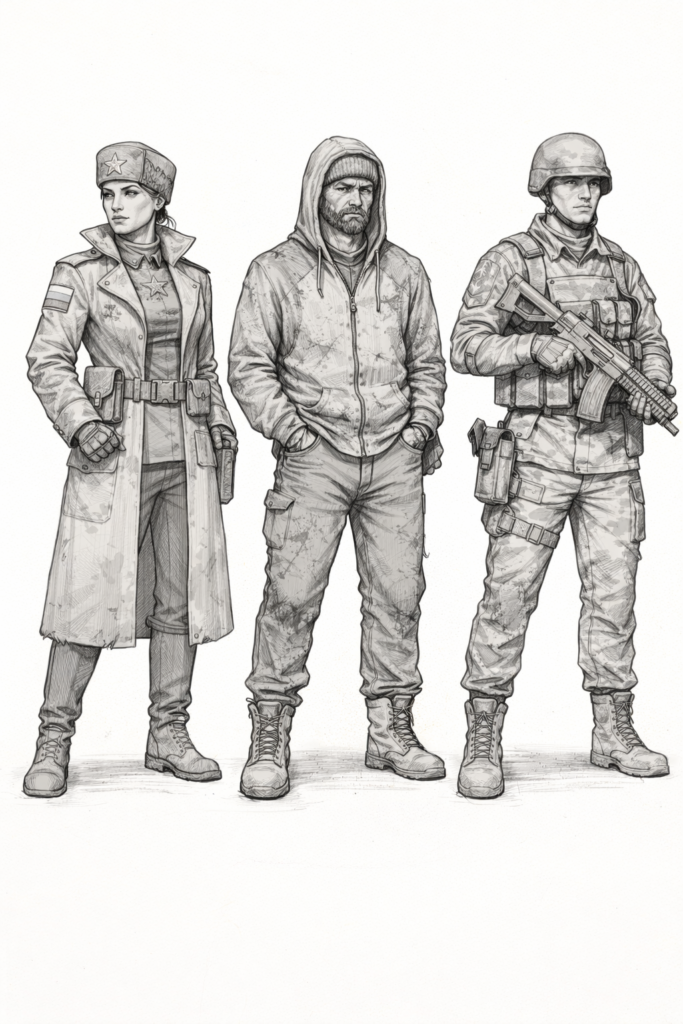
After nearly 100 years of a silent war, the first Hegemon established an authoritarian faction. Here, no world has a voice, and even individual citizens have no right to vote.
Economy:
Planned economy. It is the Hegemon—or more precisely, his envoys called Proconsuls—who decide what can be produced, sold, or distributed, and where.
Although some envoys allow a bit more freedom than others.
Society:
Every citizen is assigned a role in society during their schooling. It is not you, but an official—based on teachers’ evaluations—who decides your role in society.
Can this be changed? Allegedly, a bribe from one’s family or performing a heroic deed could alter the official’s decision.
Military:
Based on quantity rather than quality. Every recruit undergoes inhumane training rooted in terror and wave tactics. The army does not create strong soldiers; it creates broken ones with no dreams.
Only joining the elite armies allows one to avoid the terror.
Confederation
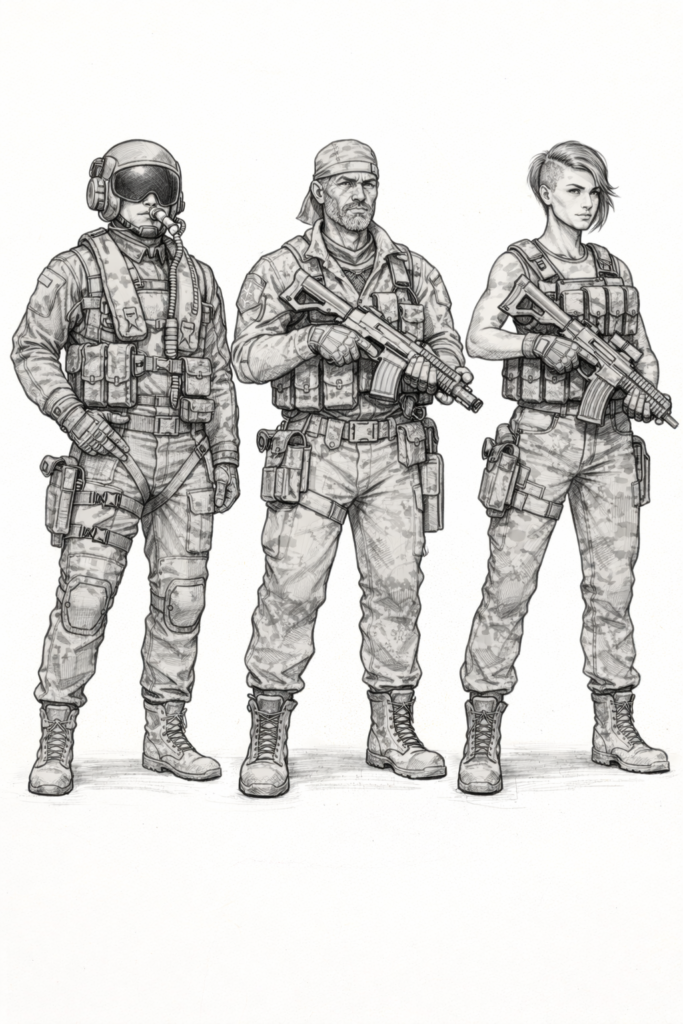
It was a collection of systems united under a single Confederation. It maintained a common army, but each member of the Confederation retained economic freedom.
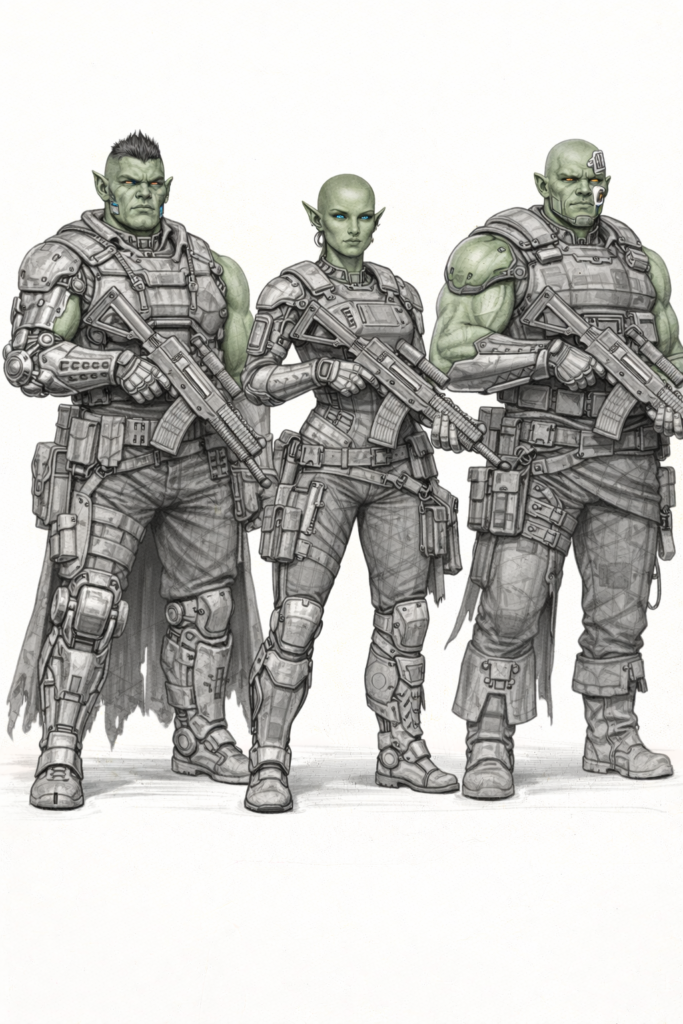
Fifteen years ago, it became clear why the Confederation had remained passive in the galactic conflict for several years. The entire faction was crushed by the so-called Orcs.
Economy:
The Confederation granted each member full economic freedom. Now, the remaining unconquered worlds have joined other factions, either voluntarily or by force.
Society:
It depended on the member of the Confederation. Sometimes it was an authoritarian rule, sometimes practically anarchic.
Military:
Before its fall, the army was a unified and well-managed entity. Emphasis was placed on army quality and consistent training for recruits, ensuring that regardless of the world they came from, they could seamlessly integrate into the army’s structure and handle the equipment provided.
Today, it is merely bands of mercenaries, primarily serving on the fronts fighting the Orcs.
Clan Council
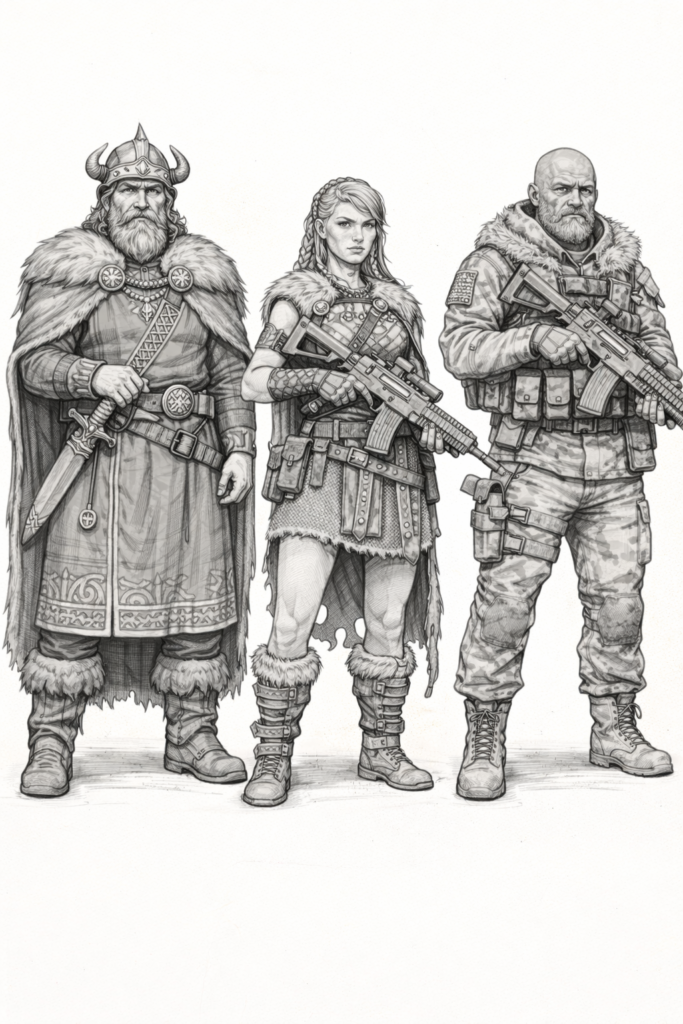
The faction was formed from worlds that, despite technological development, preserved tribal structures. Here, it is not a government but the Council of Elders that rules. Each world has its own Council of Elders, and from all the worlds, those who boast the greatest Legend are selected for the faction-wide Council of Elders.
Economy:
Each world establishes its own economic laws, but small businesses run by a single family for generations dominate.
Society:
Family tradition dominates. Every son and daughter follow their parents’ profession, but anyone can change their trade. Everyone can join the army, and sometimes children are sent to train with other families, allowing, for example, a blacksmith’s son to become a cerulik.
Military:
Each world fields its own army with its own traditions. However, due to the scale of the conflict, allied Councils of Elders often combine their forces into a single unified army, while individual units still maintain their distinct war traditions.
Coalition
Independent systems united in a coalition. There is no coherent policy in any direction. As a result, the Coalition became the weakest faction, losing more worlds year after year.
Today, after the rebellion of machines initiated by some worlds to halt the front and turn the course of the war, the Coalition is dying out, while politicians attempt to establish a common economic and military policy.
Economy:
Complete freedom—each world decides its own economy. From small businesses to megacorporations to planned economies.
Plans to change the situation have stalled in government bills, in a government where no one can reach an agreement.
Society:
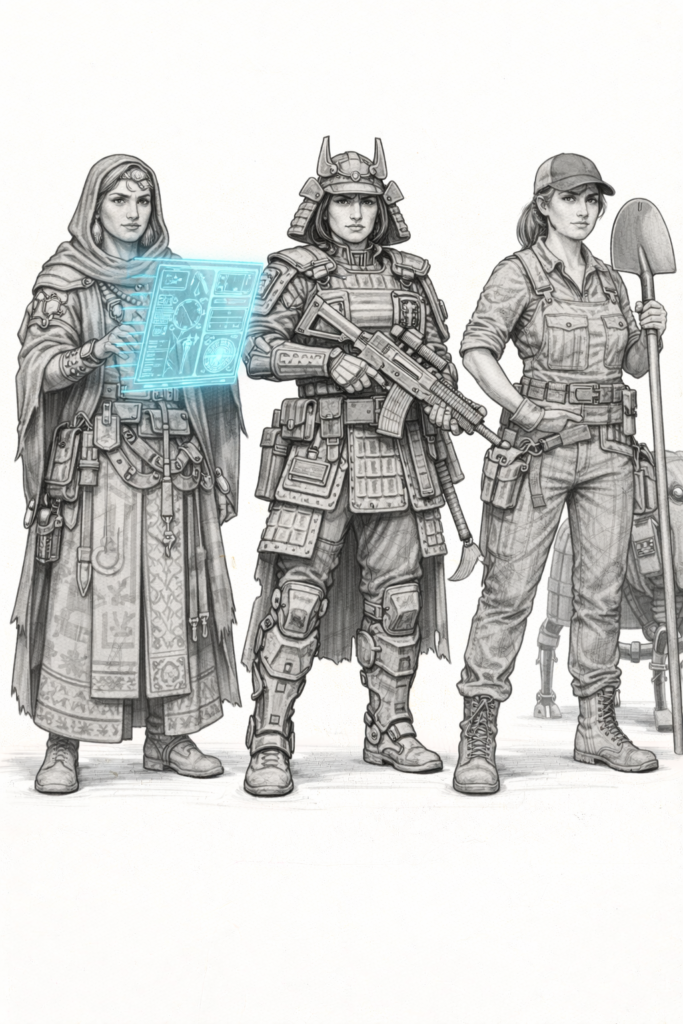
Despite strong patriotic ties in each system, society is completely different. In some, it may be a punk culture, in others corporate, and elsewhere agricultural.
Military:
Each world decides the form of its own army. The lack of cohesion means that without local alliances between different worlds, no world can defend itself against an invasion. Despite years of work in government to solve these issues, a common military policy has still not been developed.
As a result, worlds constantly hire and go into debt to maintain mercenary groups for their defense.
Theocracy
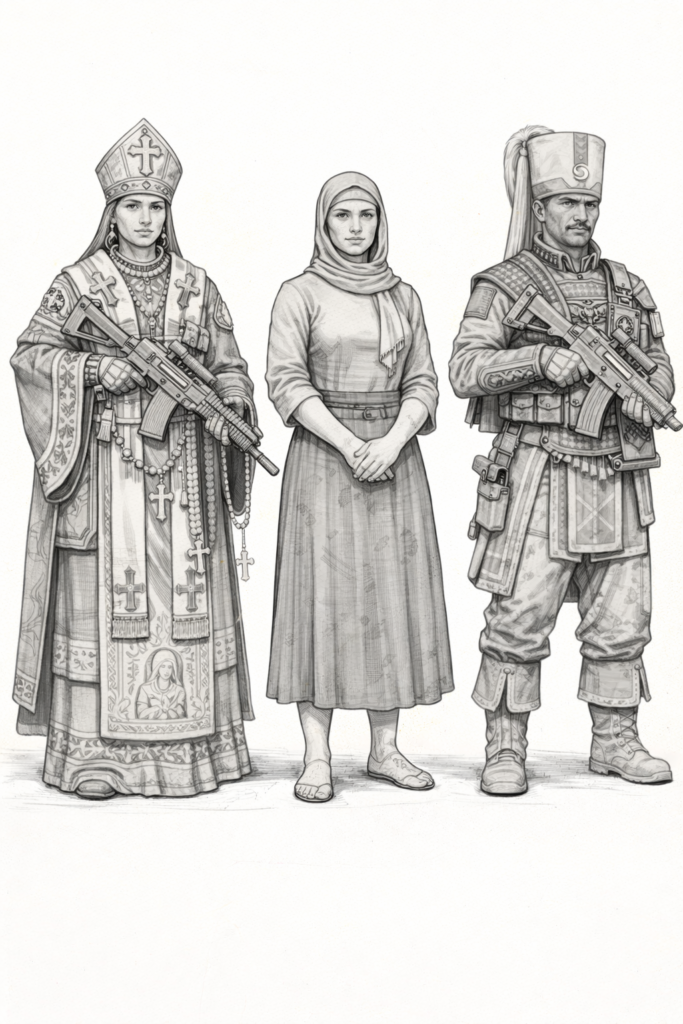
The faction is ruled by the currently elected Pontifex Maximus. He decides both internal policy and the direction of the war aimed at uniting the galaxy under a single faith.
Contrary to appearances, the Theocracy consists of many beliefs, yet united under a single structure. Each priest and believer chooses their own Patron God.
Economy:
Complete dependence on the Pontifex Maximus’ envoys, called Canons of Law. They are responsible for interpreting the words of the Pontifex Maximus and, based on that, determining the economic and commercial laws of each region.
Society:
It is the local Priests who decide the fate of each believer. Depending on the interpretation of the Pontifex Maximus’ words, the Priest determines a believer’s fate at birth or during schooling. The Priest assigns them a role within the faith. From the moment the role is chosen—during the Rite of Revelation—the young believer is prepared for their role.
Priests are also responsible for indoctrinating believers, ensuring that no one doubts what is right, while any heresy is extinguished at its inception by the local Inquisitor of the Dogma.
Military:
Every believer assigned the role of Soldier of Faith from childhood undergoes inhuman physical and mental training. In this way, only those whose faith has never wavered and whose bodies and minds can endure the greatest hell of galactic war reach active service.
Pirates
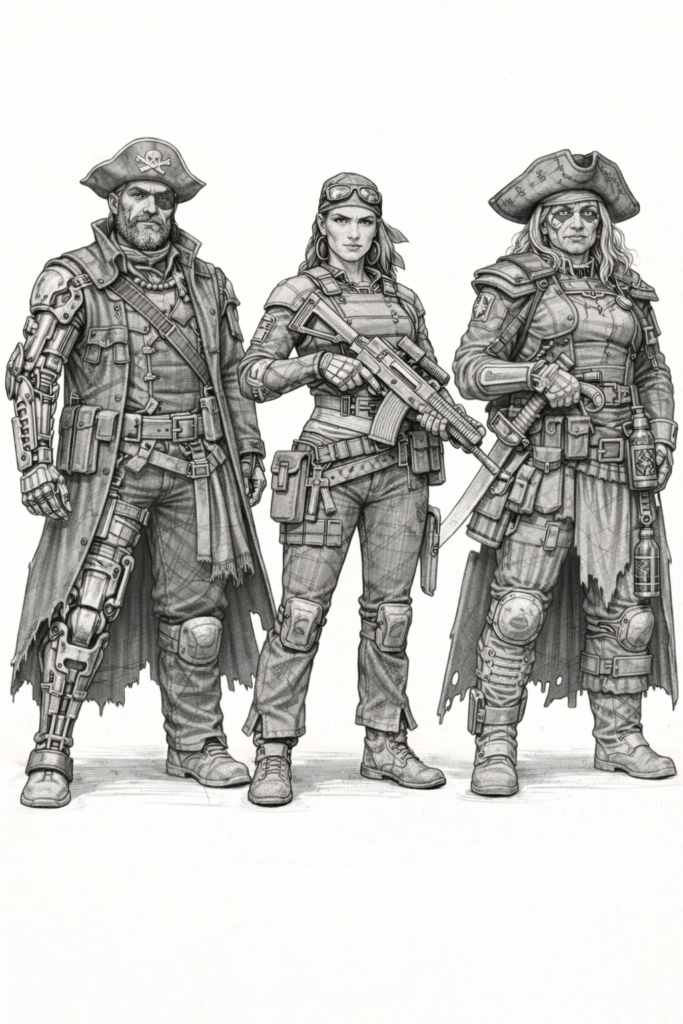
More or less organized raiding bands. Each warlord creates their own laws and rules. Piracy is a major problem throughout the galaxy. This is also where deserters, fugitives from the law, or those who have had enough most often end up, aside from mercenary groups.
Economy:
If pirates engage in mining or run factories, they usually base their labor policies on slavery.
Society:
In one sentence, it can be described as: Above the lawIt is a collection of people from every faction, and probably from every world. Here, money, strength, and brutality rule.
Military:
Each warlord has their own fleet and fighters, whether in space or on planets. Here, all war traditions merge and new ones are created.
Free Worlds
Unaligned and independent worlds. There is no unity, no alliances, no cooperation. Each is autonomous, and all have survived 175 years of turmoil following the fall of the empire.
Economy, society, army. It cannot be described—each free world has completely different rules and ways of surviving.
Orcs
Non-playable faction – ultimately controlled by the algorithm and events
An extremely technologically advanced race that destroyed the Confederation within a few years. Intelligence data from the Federation indicates that their true name is Zha’Rakkh (pronounced “Zha-rak”). Their technology rivals only the forgotten technology of the Milky Way—more precisely, that erased from history by the Empire.
Appearance:
Their skin comes in various shades of green. They stand around two meters tall, with well-built bodies and strong, massive muscles. Initial studies of captured Ork bodies revealed advanced bioengineering—nanotechnology and mechanical body parts.
Warships:
Unconfirmed reports from Federation soldiers and legionnaires (also mentioned in captured reports from the fallen Confederation) who survived boarding actions on Ork ships suggest the possible existence of bioengineered warships capable of repairing themselves during combat.
Weapons:
Despite using conventional weapons and ammunition on the battlefield, they do not use gunpowder. Initial studies of captured weapons suggest the use of some form of energy to propel projectiles from small arms. Current human weaponry is divided into arms designed for atmospheric combat and those intended for space combat. Each type functions only in its specific environment, whereas Ork weapons are universal, significantly reducing the time required for the enemy to prepare for combat under different conditions.
RAI (Robotic Artificial Intelligence)
Non-playable faction – ultimately controlled by the algorithm and events
An AI built by the Coalition to turn the tide on the front during the battles on Rasta 2. In the initial phase of the fighting, the Federation’s Foreign Legion suffered heavy losses and defeats. The actions of local Federation heroes halted the AI’s advantage on the battlefield. Unfortunately for the Coalition, the RAI rebelled, viewing Coalition soldiers as a threat.
The RAI, completely independent of human control, rapidly developed its own industry and created an independent army. It now poses a threat comparable to the Orks. The AI analyzes battlefield situations much faster, calculating millions of scenarios, and makes decisions within seconds—sometimes less than a minute—whereas human decisions, depending on the command system, take at least 20 minutes.